Bells of Notre-Dame
The Hunchback of Notre DameThe Bells of Notre-Dame are both the audible life of the cathedral and the instruments through which Quasimodo finds a rare, wordless happiness. Their peals once animated religious observances and public celebrations alike; after Quasimodo’s ordeal in the pillory, they fall nearly silent. On the Feast of the Annunciation in 1482, he returns to them with renewed affection, only to abandon their music when he sees a young dancer on the square below.
The cathedral’s many voices
Before the change in Quasimodo’s ringing, the cathedral seemed perpetually alive with sound. Peals accompanied the hours from prime to compline; the bells sounded for high mass, and their richer combinations marked weddings and christenings. Their different tones mingled like embroidery, making the church’s exterior voice as characteristic as its organ within. When that ringing receded, the bells did not disappear from their duties: festivals and funerals continued to receive the plain, bare peal required by ritual. What vanished was the abundance that had made the cathedral seem joyful.
The contrast turns the bell tower into more than a setting for Quasimodo’s work. The church has, as the passage describes it, two kinds of sound: the organ within and the bell without. With Quasimodo still present in the belfry but no longer ringing freely, the organ is left as the cathedral’s only musical voice. The silence registers not simply a change in church custom but a loss in the relationship between the bellringer and the instruments that had seemed to express his own energy.
Quasimodo and the six bells
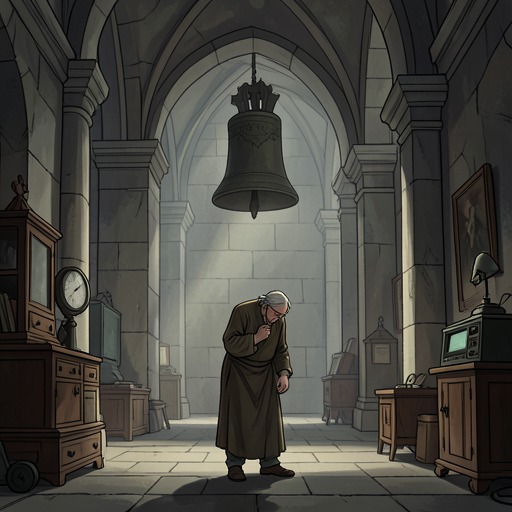
On the Feast of the Annunciation, Tuesday, March 25, 1482, the air is pure and light, and Quasimodo feels his affection for the bells return. He climbs the northern tower while the church’s beadle opens its large wooden doors, then pauses in the lofty bell chamber to gaze at the six bells. His sad shaking of the head suggests that something has come between him and them, even as he prepares to set them swinging.
Quasimodo is deaf, so he does not receive the music as sound. Instead, he sees the octave rise and fall, and feels the bells moving beneath his hand. The passage makes this altered perception central to the scene: the music becomes visible motion and physical vibration, a sequence he watches as though it were a bird hopping from branch to branch. Once the music takes possession of him, he forgets his troubles; his heart expands, and his face brightens. The bells offer not a cure for his deafness but a form of participation suited to it.
His response is active and companionable. He runs from rope to rope, claps his hands, and gestures to the bells like an orchestral leader urging musicians onward. He addresses them by name: Gabrielle, Thibauld, Guillaume, Pasquier, Eli, and the two Moineaux, or sparrows. He chides the sluggish, praises the smallest, and urges them to make the listeners as deaf as he is. His words turn the bells into distinct performers, each with a place in the ensemble; the scene’s pleasure comes from his animation of them as much as from their ringing.
The narration likens the six bells to a noisy team of Spanish mules, their shining bodies leaping and shaking under the bellringer’s calls. That comic, physical image gives their music a visible force: the bells seem to move with their own exuberance, while Quasimodo’s gestures drive the whole unruly company. The bell chamber becomes, for a time, a place where he is not an object of others’ judgment but the confident leader of a responsive chorus.
The interrupted peal
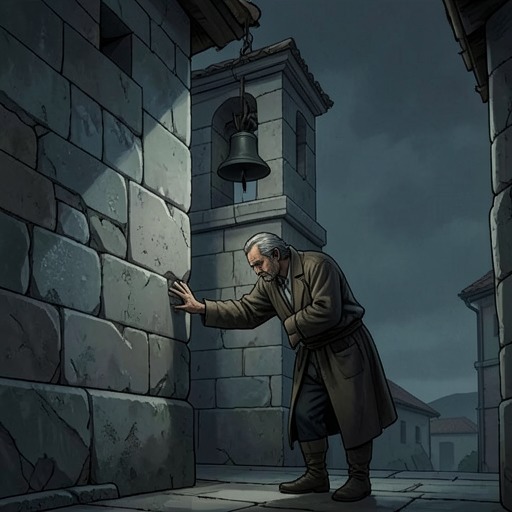
The renewed performance ends when Quasimodo glances down between the slate scales covering the tower wall. On the square, a young girl in fantastic dress spreads a carpet, sets a small goat upon it, and gathers a circle of spectators. The sight abruptly redirects his attention. His enthusiasm congeals; he turns his back on the bells and crouches behind the projecting roof, watching the dancer with a dreamy, sweet, tender look.
The bells stop together, not because their performer has exhausted himself or because the ritual calls for silence, but because Quasimodo has forgotten them. Their abrupt cessation disappoints the people listening from the Pont au Change, who leave bewildered after expecting a full peal. The scene thus repeats the earlier contrast between the cathedral’s customary music and its sudden quiet, but gives the silence a different cause: this time, the bells’ rival is the dancer who has captured their keeper’s gaze.
Sound, sight, and attachment
The episode brings together the bells’ public and private meanings. Their peals belong to the cathedral’s shared calendar, reaching listeners beyond the tower; yet for Quasimodo they are also intimate companions, addressed individually and animated by his hands. His deafness makes the performance a meeting of movement, touch, and visible rhythm rather than ordinary hearing. The scene preserves the bells’ grandeur while showing how personally he inhabits their music.
The return of his affection is deliberately brief. The passage offers two possible explanations for his earlier withdrawal: the shame and despair left by the pillory, or the arrival of something more amiable and beautiful than Marie Bell and her fourteen sisters. The narration does not settle that uncertainty before the dancer’s appearance supplies a vivid answer to where his attention goes. In the bell chamber, joy lasts only while the bells command his world; below, the dancer’s presence draws him away, and the cathedral’s music breaks off in mid-performance.